Technical Guides
- Prepared by
- Canel Elektrik İnşaat
- Published
- Updated
- Reading time
- 4 min
A factory’s monthly electricity bill shows total consumption. But how much comes from production lines, mechanical systems or individual electrical panels?
Case Study | Energy Monitoring and Industrial Electrical Systems
A factory’s monthly electricity bill shows total consumption. But how much comes from production lines, mechanical systems or individual electrical panels?
An important step in industrial energy management is moving beyond total consumption to understand where and how much electricity is used. Panel-level energy monitoring collects and evaluates electricity consumption data centrally to address this need.
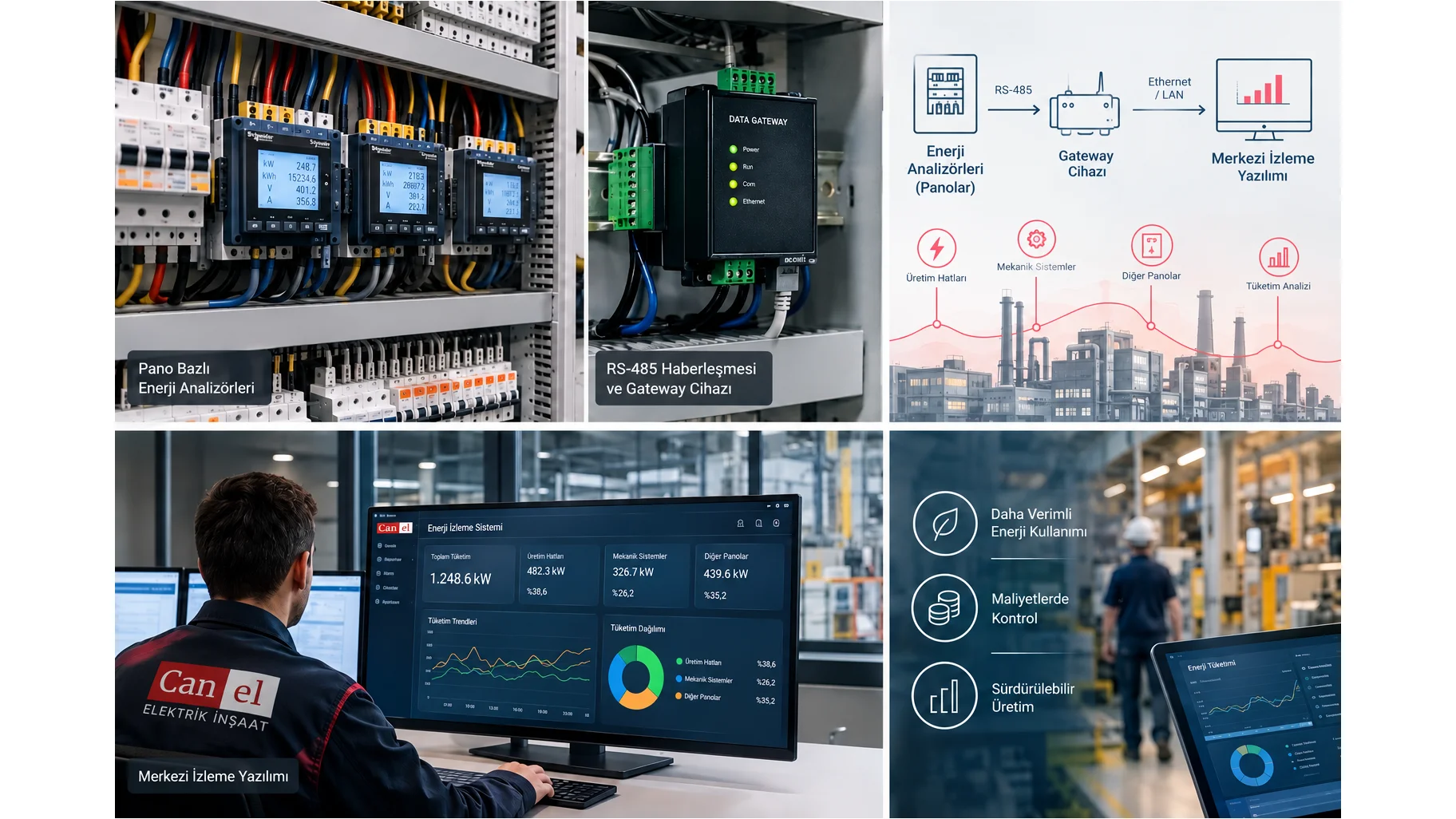
At Canel Elektrik İnşaat, we worked on the energy monitoring infrastructure implemented in the Ali Raif project, transferring data from panel-mounted power analysers to a central computer through a communication network.
1. What need does energy monitoring address?
Different production areas, machines and auxiliary systems may be supplied from separate electrical panels. Monitoring only the main meter’s total consumption may be insufficient to identify where consumption is concentrated.
Panel-level monitoring uses power analysers installed in the relevant panels to obtain electrical measurements. Depending on system design and analyser capabilities, consumption can be monitored separately for different panels.
These data help evaluate energy usage, compare consumption trends and identify potential areas for improvement.
2. RS-485 communication and gateways: how are measurements transferred?
A key component is the communication infrastructure connecting field equipment with the central monitoring platform.
Data from panel-mounted power analysers can be carried over RS-485 using appropriate protocols and connections. RS-485 is a physical communication standard widely used for serial communication between devices in industrial environments.
Depending on the system architecture, a gateway transfers data from analysers connected to the RS-485 network to the central system. Its role is to connect field communication with higher-level applications, according to the protocols and design used.
The data then reach monitoring software or the relevant application on the central computer. Authorised users can view measurements from the included panels in one place.
3. Panel-level consumption and electricity bill assessment
One important benefit is the ability to evaluate consumption separately for different panels.
Centrally collected data can be used for panel comparisons, periodic assessments and consumption trend reviews according to facility requirements.
Depending on the system scope and application features, measurements can also be compared with consumption information on electricity bills. This makes it possible to evaluate measured versus billed energy and track changes over time.
There is an important distinction: the monitoring system provides consumption data, while bill comparison and reporting depend on how the application processes those data.
4. A field example: central energy monitoring at Ali Raif and Abdi İbrahim
Canel Elektrik İnşaat participated in applications incorporating panel-level energy monitoring in the Ali Raif and Abdi İbrahim projects.
Measurements from panel-mounted power analysers are collected over RS-485 lines and transferred through a gateway to the monitoring application on the main computer. This enables central monitoring of consumption from the panels included in the system.
Bringing energy data together supports joint evaluation of different panels and a more comprehensive picture of facility energy usage. Bill tracking and consumption comparisons can be considered within the application’s available functions.
Correct communication installation, appropriate analyser configuration and accurate transfer to the central application are fundamental engineering steps.
5. Canel Elektrik İnşaat’s approach: from electrical infrastructure to monitoring
Installing energy monitoring involves more than placing analysers inside panels. Field devices, communication cables, gateway connections and the central application must work together.
At Canel Elektrik İnşaat, we emphasise coordinated progress across field infrastructure, communication components and system integration in industrial electrical and automation projects.
A well-designed monitoring infrastructure makes electricity consumption more visible and provides a data-based starting point for energy management.
The first step is to measure consumption; the next is to evaluate the data meaningfully. Panel-level monitoring helps industrial facilities track electricity use in greater detail and assess it more consciously.
Canel Elektrik İnşaat | Industrial Electrical Systems, Automation and Energy Monitoring