Technical Guides
- Prepared by
- Canel Elektrik İnşaat
- Published
- Updated
- Reading time
- 3 min
An illustrative 1,200-metre cable tray example explains how site conditions and verified project data support AI-assisted labour-hour estimates.
How many labour-hours does it take to install 1,200 metres of cable tray in an electrical contracting project? Standard unit labour coefficients can provide an estimate. However, installation height, access platform requirements, site access, material logistics and work permits can significantly change the actual duration.
AI-assisted labour-hour analysis aims to develop more realistic labour and duration estimates by considering technical project details and site conditions alongside quantities.
Illustrative case: a defence industry facility in Ankara
This is an illustrative scenario created to explain the method. It does not represent data from an actual defence industry project.
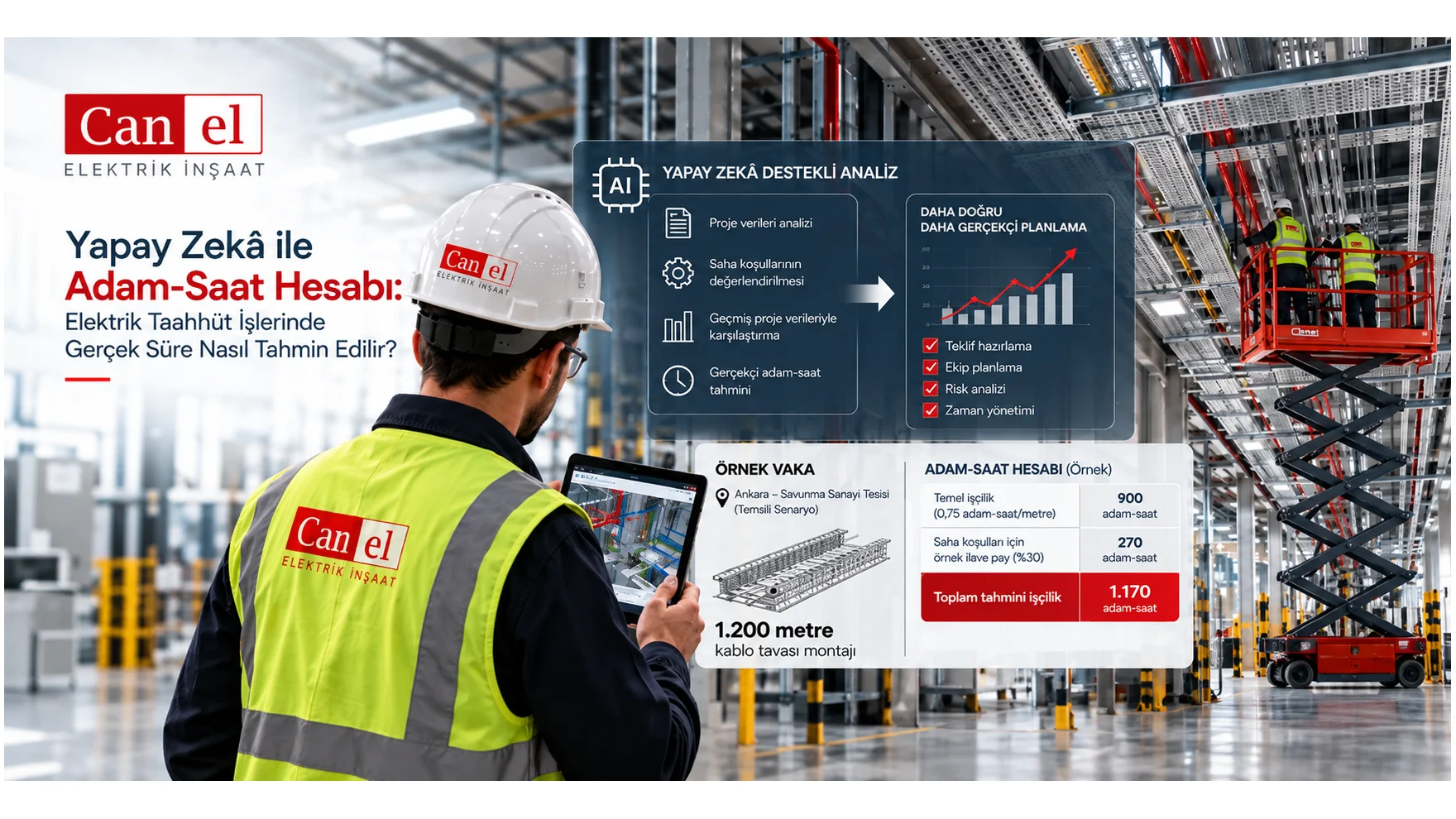
Project: Installation of 1,200 metres of cable tray and supporting systems.
An AI-assisted analysis considers the following factors:
- Installation height: Tray height above ground and access conditions.
- Access platform requirements: Scissor or articulated lift requirements, operating time and repositioning time.
- Installation complexity: Tray width, support spacing, bends, connections and custom fabrication.
- Site access: Controlled entry, work permits and daily time losses.
- Material logistics: Transport from storage to installation points and material acceptance procedures.
- Coordination across disciplines: Clashes with mechanical services, steel structures and other systems.
- Revisions and rework: Design changes, quality inspections and corrections.
How does the labour-hour calculation change?
For illustration, let us use a hypothetical coefficient of 0.75 labour-hours per metre for installing 1,200 metres of cable tray.
| Calculation item | Result |
|---|---|
| Base labour | 900 labour-hours |
| Illustrative additional allowance for site conditions (30%) | 270 labour-hours |
| Total estimated labour | 1,170 labour-hours |
The 30% allowance is an assumption selected solely to demonstrate the calculation method. It is neither an industry average nor an actual project result. The actual coefficient should be established using recorded labour-hours from past projects. The effect of factors such as access platform use should not be counted twice.
What does AI do differently here?
Traditional calculations mainly use quantities and standard labour coefficients. An AI-assisted model compares quantities, actual labour-hours, installation heights, team sizes, access platform usage and site logs from past projects to generate an estimate for a new project.
This can support questions beyond “How many labour-hours will this work take?” It can also help assess which site conditions could extend the duration, what team size is needed and how realistic the planned handover date is.
The approach depends on supplying the model with the company’s verified past project data and regularly comparing predictions with actual results. AI does not automatically have access to companies’ private data.
Conclusion
Accurate labour estimation in electrical contracting involves more than measuring metres. Installation height, access platform requirements, site access, logistics and team productivity should be assessed together.
AI-assisted labour-hour analysis can turn past project experience into measurable data and support quotation preparation, team planning and assessment of delay risks.