Technical Guides
- Prepared by
- Canel Elektrik İnşaat
- Published
- Updated
- Reading time
- 4 min
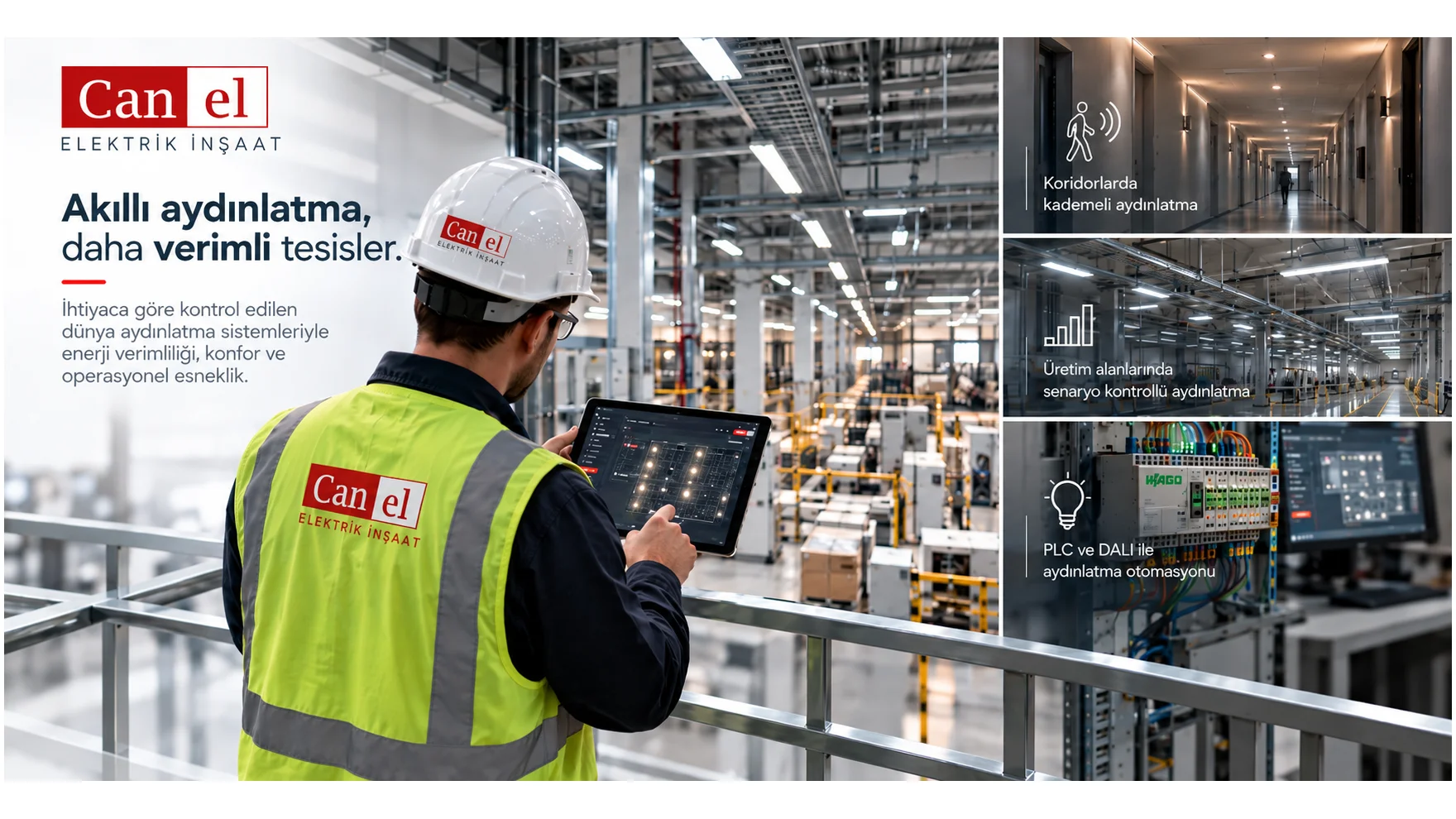
Corridor lights switching on progressively as movement begins, production-area lighting controlled through different scenarios, and light levels adjusted to demand are among the possibilities offered by industrial lighting automation.
Case Study | Industrial Electrical Systems and Automation
Corridor lights switching on progressively as movement begins, production-area lighting controlled through different scenarios, and light levels adjusted to demand are among the possibilities offered by industrial lighting automation.
Factory lighting today involves more than providing sufficient illumination. Adapting lighting to operating patterns, controlling different areas independently and adjusting the output of suitable luminaires are important considerations in modern industrial design.
How are these systems implemented in a real production facility? Which engineering steps connect electrical and automation design with installation on site?
Progressive corridor lighting: a small detail with a different user experience
Imagine walking down a production facility’s corridor. Rather than all lights switching to full output at once, they activate progressively according to a defined scenario.
This is one lighting automation scenario that can be implemented with the right control infrastructure and compatible equipment. Whether it uses motion sensors, a time schedule or another trigger depends on the project design.
Suitable systems can also control separate areas, switch luminaires on and off, and adjust the output of dimmable fixtures.
The central engineering consideration is designing a control scenario that matches how the facility is used, as well as deciding how lights should operate.
PLC controllers and DALI: the technology behind lighting automation
Different control components work together in industrial lighting automation. WAGO control infrastructure, appropriate power supplies and input/output modules can help establish communication between field devices and the automation system.
DALI (Digital Addressable Lighting Interface) is a lighting control standard that enables digital communication with compatible lighting drivers. Suitable equipment allows switching and light-level control.
Combined within an appropriate system architecture, these technologies enable different lighting groups to follow defined scenarios.
The same equipment combination is not suitable for every project. Controllers, modules, DALI interfaces, drivers and field devices must be evaluated together during design.
From fluorescent lighting to LED: upgrading the infrastructure
Upgrading older lighting systems is an important issue for industrial facilities. Replacing fluorescent lighting with LED systems may require a reassessment of existing electrical infrastructure and control methods.
An LED conversion should be considered beyond replacing lamps. Luminaire performance, electrical connections, driver compatibility and communication with automation systems need to be assessed together.
Under suitable conditions, dimmable LED fixtures and automation provide more flexible lighting management. Potential energy savings depend on selected equipment, control scenarios and the facility’s actual usage patterns.
An engineering example from the field: lighting automation in pharmaceutical facilities
At Canel Elektrik İnşaat, our lighting automation work in pharmaceutical production facilities has included progressive corridor lighting scenarios and facility-wide automation solutions.
Our applications in the Abdi İbrahim and Ali Raif projects reflect our engineering experience in configuring lighting systems around facility-specific control scenarios.
Success in these applications depends on more than selecting automation equipment. Material procurement coordination, installation, electrical and control connections, programming and commissioning need to progress together.
Within the project scope, Canel Elektrik İnşaat coordinates these processes with the aim of implementing the designed lighting scenarios correctly on site and verifying them through functional tests.
Conclusion: lighting automation gains value through sound design
Industrial lighting automation makes lighting manageable according to actual usage requirements, instead of maintaining a fixed operating pattern.
Progressive corridor lighting, sensor-controlled applications, DALI light-level adjustment and LED conversion can be combined through appropriate engineering.
At Canel Elektrik İnşaat, we approach industrial electrical and automation projects according to technical requirements, site conditions and customer usage scenarios. Our integrated approach covers design, material coordination, installation and commissioning.
Good lighting automation also designs how light will adapt to the facility’s operating patterns.